

In-Touch & Distillate: Two Ways of Seeing the Self
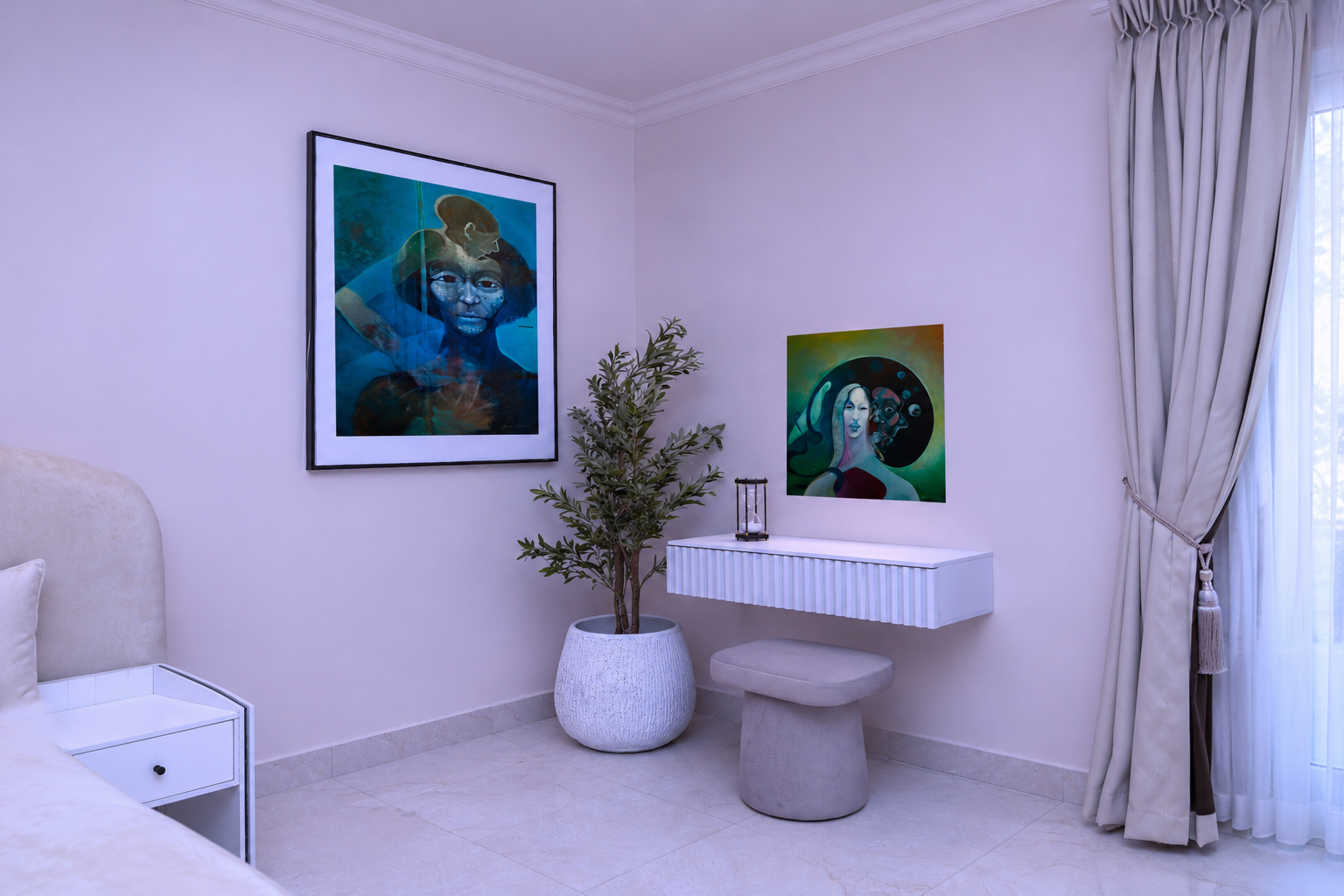
A revisit to the metaphysical world of Joshua de Bliquy
A year after revisiting Joshua de Bliquy’s Words Don’t Come Easy, we return to an artist whose work asks us to look beyond what is immediately visible.
De Bliquy’s paintings inhabit a space between the physical and metaphysical. Figures emerge, overlap and recede into fields of colour, suggesting that identity is never quite as singular or fixed as it appears. Thought, memory, feeling and experience seem to occupy the same space as the body.
This becomes particularly compelling when In-Touch and Distillate are considered together.
In-Touch
In-Touch places the viewer in direct relationship with the figure. The face meets us head-on, while another presence appears behind and above it; a figure within the figure, or perhaps a memory, thought or other dimension of the self.
The work has a strong sense of looking and being looked at.
There is intimacy here, but also distance. The central face appears grounded in the physical world while the overlapping forms suggest everything that cannot be seen so easily: relationships, impressions, histories and the internal lives we carry with us.
The title In-Touch becomes almost philosophical. To be in touch is not simply to make contact with another person. It can mean being connected to one’s own interior world; to thought, feeling, memory and the people and experiences that shape us.
Distillate
Where In-Touch feels outward-facing, Distillate turns toward substance.
A luminous figure occupies the centre of the painting, while another face emerges behind her from the darker field. The two presences appear almost inseparable, as though the visible self contains another world within it.
This is where the title becomes significant.
A distillate is what remains when something has been concentrated down to its essential substance. In de Bliquy’s visual language, that substance can be understood as everything accumulated beneath identity; thought, feeling, experience, memory and language.
The painting asks us to consider what remains when we move beyond appearance.
Not simply who am I?
But:
What am I made of?
A dialogue between two works
Seen together, In-Touch and Distillate create an intriguing conversation.
One considers connection.
The other considers substance.
One reaches into the relationship between self and other.
The other looks beneath the surface of the self.
Both occupy the metaphysical territory that runs throughout de Bliquy’s practice: the suggestion that the invisible world around us is not really separate from physical existence.
For collectors, this is part of what makes the works rewarding to live with. They don’t offer a single, closed interpretation. Their layered figures and shifting spaces allow the meaning of the work to change with the viewer… and perhaps with the room in which it lives.
A painting can become part of a collection not only because of what it depicts, but because of what it continues to reveal.
In-Touch and Distillate belong to that kind of conversation.
They invite us to spend time with the space between the visible and invisible… between person and presence, thought and form, surface and substance.
Joshua de Bliquy’s work is available through Unsung Art.